Board Cheat Sheet: Five Roles Your Board Can Play to Boost Fundraising, 2025-26 Edition
(October 2025)

We're all feeling it—the weight of uncertainty, with little relief in sight. It's hard to know where to focus.
For nonprofits, the list of challenges keeps growing: a volatile economy, federal funding cuts, canceled grants, staff burnout, donor fatigue, inflation, even natural disasters—and now, major tax changes on the horizon.
And yet, one challenge consistently rises to the top: board engagement. Depending on the study, anywhere from 60% and 75% of nonprofits report engaging their boards as a chronic problem, especially when it comes to fundraising.
How can you activate your board when traditional strategies aren't working? When what you need from board members is real-world insight and fundraising support, but what you get feels like avoidance or detachment?
Below are five ways to re-envision how to partner with your board. Nonprofit boards are constituted differently, so every suggestion on the list won't be apropos for every board member. But they're all productive roles you can ask board members to play to get the dialogue flowing, create deeper awareness, and inspire the action you need.
Think of them as avatars—personas your board members can inhabit to help you better understand your donor community and build fundraising capacity from the inside out.
1. The Focus Group Participant
Your board is a ready-made focus group. As a cross-section of your community, members can offer insights and help you refine how you communicate impact.
Great communicators know that messaging is strategy and strategy is never static; it evolves to meet the moment. This isn't a year for cookie-cutter year-end appeals. Instead, ask your board members:
How are you feeling about charitable giving these days, and why?
What makes a message feel urgent or meaningful to you?
What impacts are we making that stand out in this environment?
Their answers can help you fine-tune your messaging so it resonates with your donor community. It may even suggest options for A/B testing. And remember the saying: "When you ask for money, you get advice. When you ask for advice, you get money." Asking your board for feedback keeps them engaged and focused on fundraising in a fresh, low-pressure way.
Plus, with donor counts continuing to decline and 81% of all gifts last year at a level of $500 or less, retaining your everyday donors with effective messaging should be a top priority for all nonprofits.
2. The Corporation Whisperer
With major tax changes coming in 2026, corporate giving may be shifting once again. Companies will now be required to give more than 1% of their taxable income to qualify for a charitable deduction—an increase that could change how they think about ways to impact their communities.
Sponsorships (business expenses that are fully tax-deductible), in-kind contributions, volunteership, and workforce engagement agreements may see renewed energy; outright grants may see less funding and thus become even more competitive.
Board members who work in the corporate world can be your inside track. They can help you understand how area companies are thinking about their giving and maybe even open some doors along the way.
3. The Data Driver
Great fundraising lives at the intersection of data and storytelling. Donors want to know: What differences are we making together? What results can we see?
Many nonprofits either collect too little data, or way too much. And they struggle to make sense of what really matters.
Board members often deal with metrics and analytics regularly in their own work. Tap into this expertise. Ask them:
What kinds of metrics drive decision-making in your field, and why?
How do you tell a good story through data?
They can help you think about KPIs and other outcome measures that seem truly compelling from a donor perspective, so you craft stories with numbers that speak to audiences rather than at them.
4. The Professional Development Field Guide
Professional growth and upskilling rank high on the list for most nonprofit staff members. But today's training budgets are limited. Luckily, your board can help here, too.
Board members with expertise in fields ranging from marketing, sales, and digital technology to HR, finance, law, or risk management can share industry insights and trends with your staff, helping them to puzzle through parallels and counterpoints in their own work. AI is on everyone's mind. Any board member actively using AI in the workplace can help staff think about productive applications, but also caveats and guardrails.
Informal learning sessions and coaching don't just build skills. They build relationships between staff and board, deepening understanding across the organization. And they demonstrate that leadership recognizes what staff desire most for growth and success.
5. The Pipeline Builder
Acquiring new donors and building pipelines is one of the toughest challenges all nonprofits face today. Research shows that donor counts keep shrinking. And in our attention economy, it's harder than ever to cut through the noise to attract new supporters.
That's where your board comes in. They're your ambassadors, your "social proof." Encourage them to share your posts on social media with a personal endorsement. If you've already tested messaging with them, they'll be confident—and proud—to spread the word!
Plus, events may be having a moment in terms of fundraising strategy and donor acquisition, and they offer great opportunities for board participation.
A decade ago, events were widely panned by sector leaders as "sacred cows" that needed to be eliminated. The pandemic seemed to hasten their demise. But they're gaining fresh traction as people seek community and genuine connection in a post-pandemic world where we're spending increasing amounts of time online and alone. When you do offer events, make it easy for board members to participate, including planning, sponsoring, hosting, speaking, and bringing new faces. Ask each member to invite one or two new guests and follow up with those connections afterward. A simple invitation can lead to meaningful new relationships.
Two additional roles your board can play are universal, but they couldn't be more relevant today.
The Strategy Partner
Board members have a responsibility to ensure that your revenue strategies are sound as part of their duty of care. But they can also be your best strategy partners.
Now is the time to roll up your sleeves together and dig into your business model and revenue plans. Justify your "whys" and other assumptions. Run through exercises where you play out different scenarios. Develop a relentless habit of asking, "What am I missing?" You'll gain valuable insights and identify vulnerabilities and flaws. And your board members will gain a deeper understanding of the real work behind the numbers.
The Cheerleader
Never underestimate the power of encouragement. A quick "thank you" or "you're doing great!" from a board member can go a long way in keeping morale high, especially in tough times.
So, too, can social time before or after board meetings, as well as active, intentional communication between staff and board members between formal meetings.
Bottom Line
Most people think of nonprofit boards in terms of governance. But your board can—and should—be so much more than a governing body. The best governance is characterized by purposeful collaboration, not rule enforcement. And it should never feel like an impenetrable wall.
Purists will insist that governance and operations should never mix, and ideally, operational decisions belong to staff. But in reality, nonprofits are led legitimately (and of necessity) with a variety of models. The late John Carver, father of the modern nonprofit board, famously once said, "Boards are...social constructs, which is to say that their purpose is what we say it is." Inviting feedback and testing assumptions can widen the aperture. Decisions made through too narrow a lens often suffer from blind spots and disconnects.
Healthy, productive boards are ready-made support systems, valuable resources, and reflections of their donor communities. When you engage board members effectively, you don't just improve your fundraising. You strengthen your entire organization and help members help you based on genuine understanding.
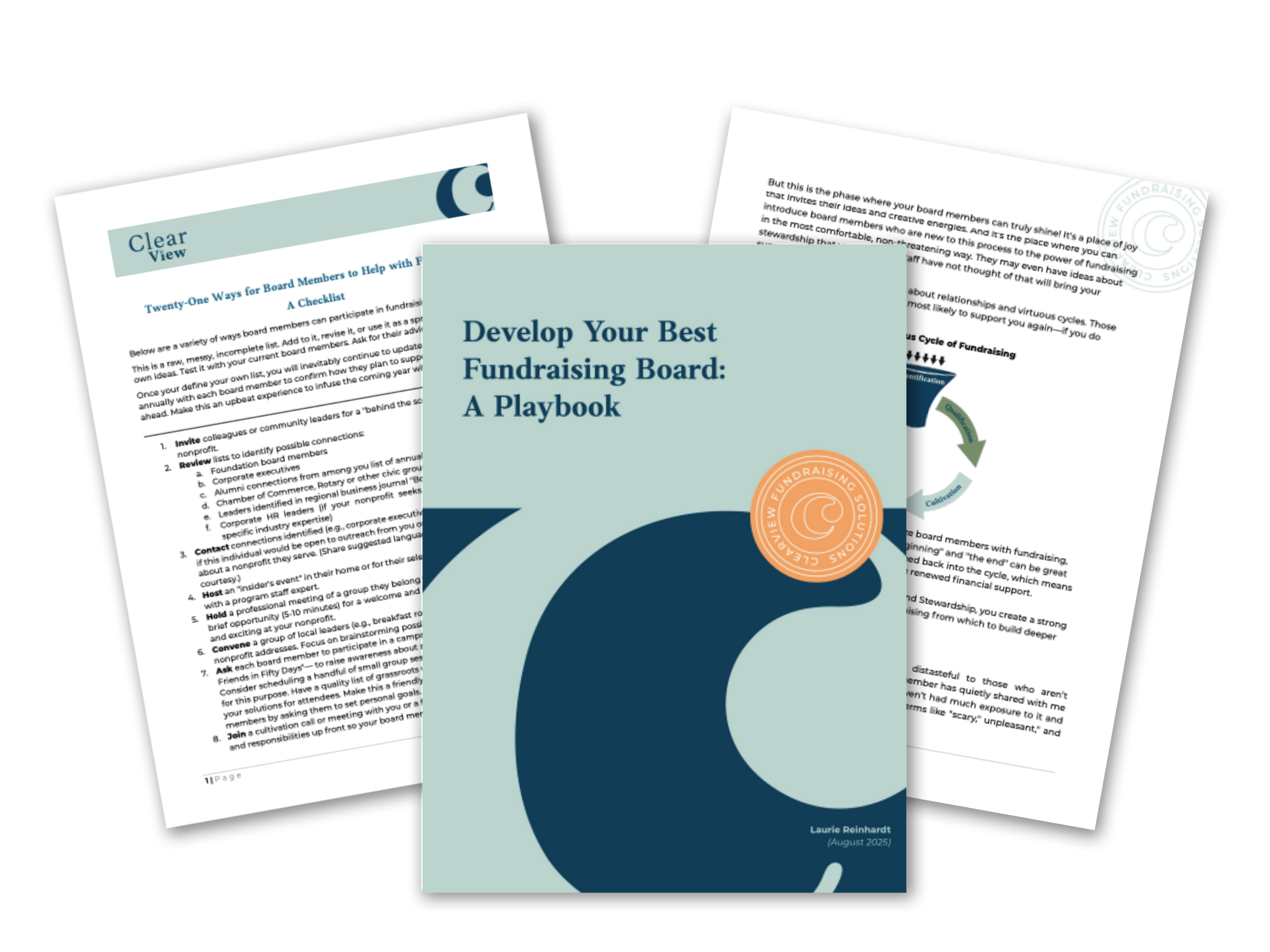
For more on how to fundraise better with your board, download my playbook and checklist.
They're Free!

Visit My Resources Page
for more "to know" and "to do" insights to help you fundraise better.
AUTHOR
Laurie Reinhardt, PhD, MBA
Founder, ClearView Fundraising Solutions
I help nonprofit leaders, boards, and staff work smarter together, so they raise more money.
SHARE THIS
COMMENTS
© Copyrights by ClearView Fundraising Solutions, LLC. All Rights Reserved.